Genealogy begins as an interest,
Becomes a hobby;
Continues as an avocation,
Takes over as an obsession,
And in its last stages,
Is an incurable disease.
–Author Unknown
Genealogy begins as an interest,
Becomes a hobby;
Continues as an avocation,
Takes over as an obsession,
And in its last stages,
Is an incurable disease.
–Author Unknown
Life in the 1920 is not life in the 2010’s. I went searching for information in the 1920’s, specifically about North Carolina, to try and gather some perspective about the life of Jennie Elizabeth Payne and how her life was different than mine.
I know that prohibition began in the 1920’s and women were given the right to vote. I wonder if my grandmother voted in the 20’s? Warren G Harding and Calvin Coolidge were the presidents in the 1920’s. What did she think of them? And did the family respect prohibition or was it just something they had to work around?
I found an interesting site NCpedia which had a article Women in the 1920s. It is interesting to note that NCSU began accepting women in 1921 but didn’t actually have one graduate until 1926. UNC also allowed women to attend in 1921, but “the student newspaper headlined, Women Not Wanted Here. ” Yikes! I know that grandmother worked as a nurse at one point, so she probably had some education.
Crowder Mountain was a rural area, and electricity was not the norm and bathrooms were usually outhouses. I would not have done well.1 Life could not have been easy on the farm.
I know that I saw that some people were working in Mills in the 1930s in the surrounding houses. I need to do a survey of the census and see what people did for a living and how that changed from 1920 to 1930s. Another task for the to-do list.
The Library of Congress does not have any North Carolina newspapers digitized. I’ve had a lot of luck with Virginia newspapers.
GenealogyBank has digitized images of the Charlotte Observer in the 1920’s. I doubt I’ll find any of my Payne’s in there, but it would be good just to get a feel for what was important. I’ll put that on the list for another day.
I’m going to tackle the survey of the census next to try and understand the neighborhoods they live in. And I think it is time for a timeline. Nothing puts details together like putting them in chronological order.
Footnote
1. Government and Heritage Library at the State Library of North Carolina,”Women in the 1920s in North Carolina, NCpedia.org (http://www.ncpedia.org : accessed 3 Jun 2012).
When we looked at Jennie Elizabeth Payne in the 1930 census, we were left with the question, why was Jennie, 22, was living on a farm in Crowder Mountain, North Carolina with 4 brothers and 3 sisters? The oldest brother, Floyd, owned the farm which appeared to be family run. 1 The story we find is a sad one.
Let’s step back to the year 1920. Jennie is 12, and living with her parents, James, 37, and Georgie, 36, Payne. James owned his farm with a mortgage on Kings Mountain Road in Crowder Mountain, North Carolina. He lived there with his wife, 3 daughters, Lela, Jennie and Daisy and 4 sons, Boyce, Floyd, Thomas and Robert. His sons and oldest daughter worked the farm.2 Later that year, James and Georgie added another daughter to the family. In 1922, their fifth son Otto is born.3
But December 27, 1922 found James Payne suffering from influenza and pneumonia and on January 5, 1923 he died leaving his wife and 9 children.4 Five years later, tragedy strikes the family again. In November 1927 Georgie was suffering from pneumonia and on February 3, 1928 she also died.5
And in 1930, the 8 of the brothers and sisters are living together on the family farm without their parents.
The story is not the records, the story comes from the records.
Footnotes
1. 1930 U.S. census, Gaston County, North Carolina, population schedule, Crowder Mountain Township, p. 133 (stamped), enumeration district(ED) 9, sheet 18A, dwelling 280, family 314, Jennie E Payne; digital image, Ancestry.com (http://www.ancestry.com : accessed 31 May 2012); citing NARA microfilm publication T626, roll 1691.
2. 1920 U.S. census, Gaston County, North Carolina, population schedule, Crowder Mountain Township, pp. 65-66 (stamped), enumeration district(ED) 75, sheet 6B-7A, dwelling 97, family 106, Jennie E Payne; digital image, Ancestry.com (http://www.ancestry.com : accessed 1 Jun 2012); citing NARA microfilm publication T625, roll 1299.
3. 1930 U.S. census, Gaston Co., North Carolina, pop. sch., p. 133 (stamped), dwelling 280, family 314, Jennie E Payne.
4. North Carolina, State Board of Health, death certificate #421 (stamped) (1923), James R Payne, Bureau of Vital Statistics, Raleigh; digital image, Ancestry.com (http://www.ancestry.com : accessed 1 Jun 2012); citing Microfilm S.123. Rolls 19-242, 280, 313-682, 1040-1297.
5. North Carolina, State Board of Health, death certificate #397 (stamped) (1928), Georgie E Payne, Bureau of Vital Statistics, Raleigh; digital image, Ancestry.com (http://www.ancestry.com : accessed 1 Jun 2012); citing Microfilm S.123. Rolls 19-242, 280, 313-682, 1040-1297.
Teasing the story out of the records is half the battle. Presenting the story so it is interesting, well that is something else.
I love this particular example: Everything I know About Hyman Victor (a link from Elliot Malkin’s site dziga.com)
Each piece of evidence, each record is presented as Exhibit. Each Exhibit has a picture or image and a description that helps the reader understand the image and a bit more about Hyman Victor.
I love its simple yet powerful presentation. It is compelling. And it has the ability to be updated easily. Find a new document? It’s easy to add.
If you are looking for inspiration on how to tell the story of your ancestor’s, look to see what others have done. Inspiration is everywhere.
Census records are great for giving us birth events, names and relationships (stated or presumed) and depending on the year other various event and identity information. But I do believe that every census tells a story, with the questions it begs us to ask.
My grandmother was Jennie Elizabeth Payne and she was born in North Carolina. In 1930, I find her living in Crowder Mountain, North Carolina with her brothers and sisters.1
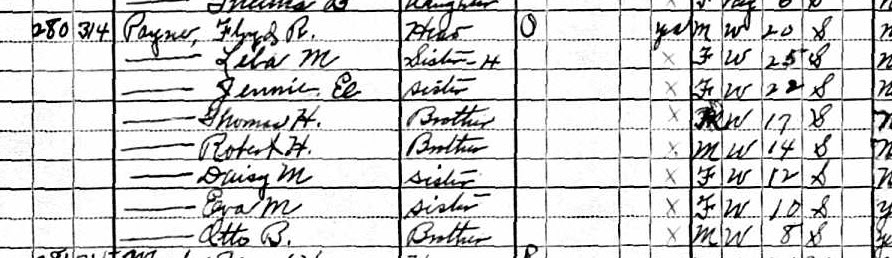
I think too often we gather the names, the vitals and the relationships and move on. Or maybe we transcribe everything off the record. But what is the story that this document tells us? What are the questions that it is begging us to ask and then answer?
A quick look tells us that particular census is not the basic family unit we expect to see. Where are the parents? There are some fairly young children in this household; Otto B is only 8. Where are his mother and father and why have they left their youngest children to be raised by their oldest.
Floyd R Payne, Jennie’s brother, owns the house. This is not typical for a 20 year old single male in this area. Floyd is listed as a farmer on a General Farm, and his two brothers, Thomas and Robert, are listed as laborers on a Farm, presumably the family farm. None of the sisters are working and Lela and Jennie are in their 20’s. So it would appear that the family is not destitute.
So how did they end up in this situation? Are the parents dead? Is there some other reason for this family setup? It’s not that they were living here in this particular time and place, the story will come from why were they living here in particular time and place and where are the people we expect to be there.
The story begins by asking the right questions.
Footnote
1. 1930 U.S. census, Gaston County, North Carolina, population schedule, Crowder Mountain Township, p. 133 (stamped), enumeration district(ED) 9, sheet 18A, dwelling 280, family 314, Jennie E Payne; digital image, Ancestry.com (http://www.ancestry.com : accessed 31 May 2012); citing NARA microfilm publication T626, roll 1691.
When I first started doing genealogy it was all about growing the tree, going back one more generation. But before too long I had a tree with a bunch of records attached. Something seemed to be missing. I still needed to be in touch with who these people were.
Genealogy or Family History is not just kinship. It is also about identity. Who were my ancestors? What were there lives like? Each record holds a piece of the puzzle. I’ve talked to a lot of people who do genealogy and many want to tell the story and many don’t know where to start. I think the key is to do it as you go.
I want to do two things in this blog:
1. Talk about techniques we can use to help us tell the story
2. Tell a few stories as I go.
Let’s begin.
 cluster genealogy