Category Archives: Genealogy

Can’t Make It To A Genealogy Conference? Attend RootsTech At Home

Thousands of genealogists will descend on Salt Lake City Feb 3rd-6th for RootsTech 2016.  It’s an interesting blend of technology and genealogy that covers the beginner to the advanced genealogist.

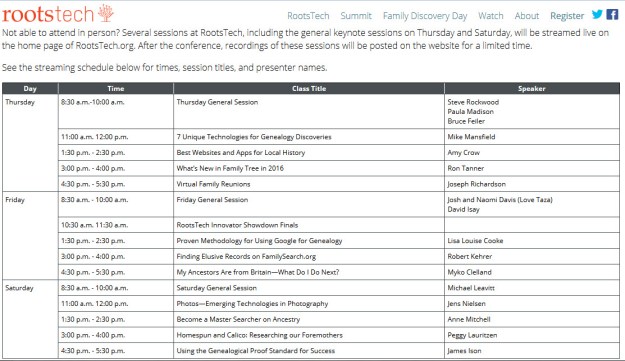
But what if you can’t make it?  You’ll miss the fun of being around so many like minded people and the wide array of classes that will give you new insights and ideas for your research.  But don’t despair if you can’t make it.  The powers that be at RootsTech 2016 have decided to livestream some classes on Thursday, Friday and Saturday so that you can get a taste of what is going on.

And I am delighted to have been chosen to present my class Become a Master Searcher on Ancestry on Saturday as a livestream class.

So clear your schedule.  Circle some classes that sound interesting.  Remember the times are Mountain time , so plan accordingly. Get ready to learn and be inspired!

rootstech

A Google Search Technique To Add To Your Bag of Tricks

You probably know google is powerful search engine and you probably know that the rootsweb message boards are chock full of useful information about your ancestors and the locations they lived.

Did you know that you can combine them easily?

In the google search bar type site:<url of the site> like this:

google rootsweb01


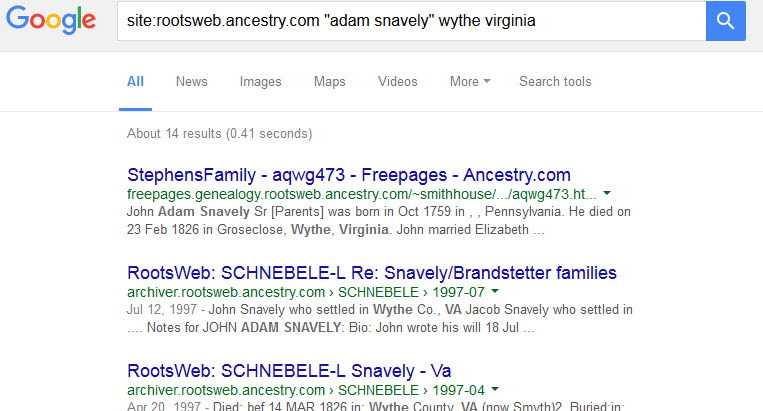
Then add in your search query.  Let’s say I am looking for Adam Snavely in Wythe, Virginia. I can try something like

google rootsweb02


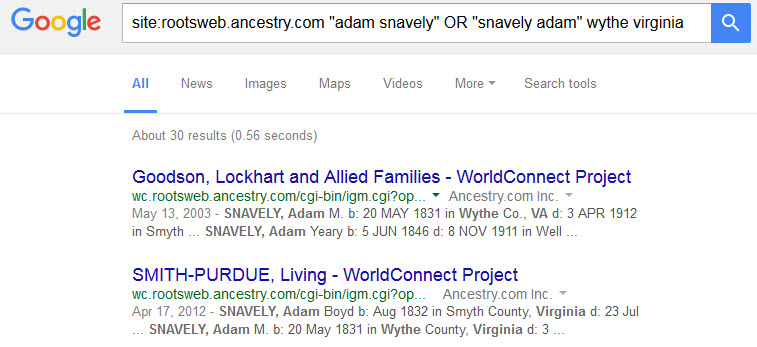
Notice that I put double quotes around adam snavely.  That tells google that if adam and snavely don’t appear right next to each other don’t show me the result.  But you’ve probably seen more than a few posts that use surname, first name so you might want to try

google rootsweb03

You’ll notice that I have 30 results instead of 14.

You can try this with any site that is indexed by google, which is a pretty lengthy list.  Give it a try — you never know what you might find with a new search technique!

Yep. I’m Not Building Family Trees — I’m Building Family Graphs

A couple of days ago I published Family Tree or Family Graph and was delighted at the comments I received. Some of you knew exactly what I was talking about!  And Chris from NM and I had discovered our shared Snavely line!

So I started digging back into the Snavely line.  I’m presenting at the Family History Institute of Southwest Virginia on April 2nd and Chris got me to thinking about old unsolved problems.  And it’s always good to talk about local families at presentations.

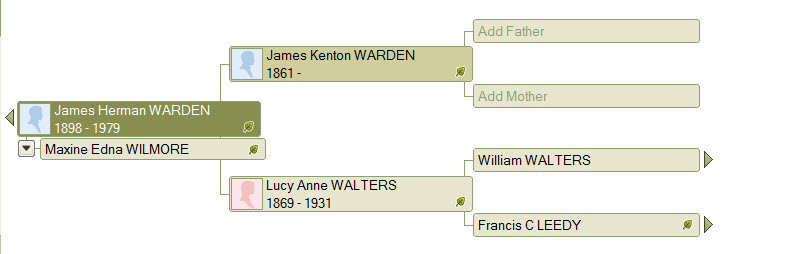
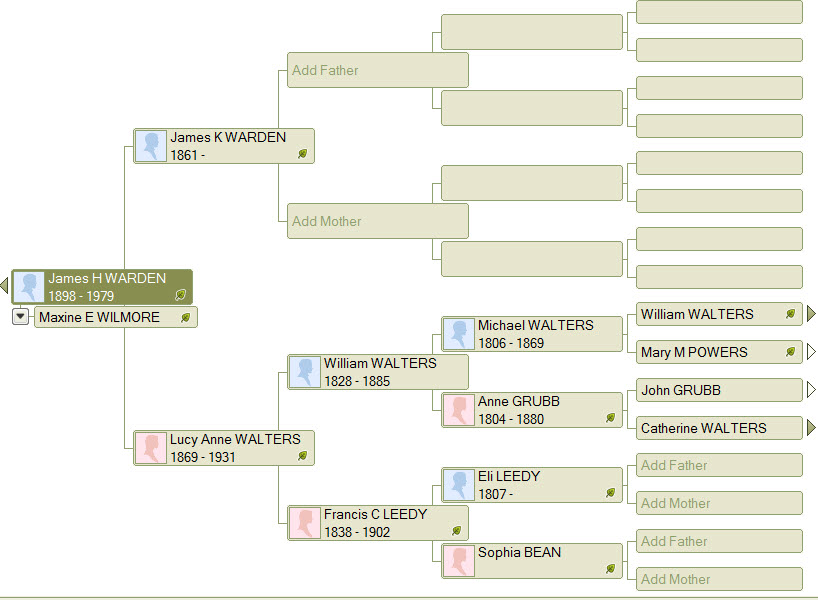
I was trying to find the death date of Maxine Edna Wilmore Warden and came up empty.  But I did find her husband’s and his parents.  (Love those Virginia Vital records!) The name WALTERS looked very familiar.

more on family graphs01

So I dug through census, vitals, trees and some of my books. I built the Walters line back to William Walters and Mary M Powers and those names looked very familiar.

more on family graphs02

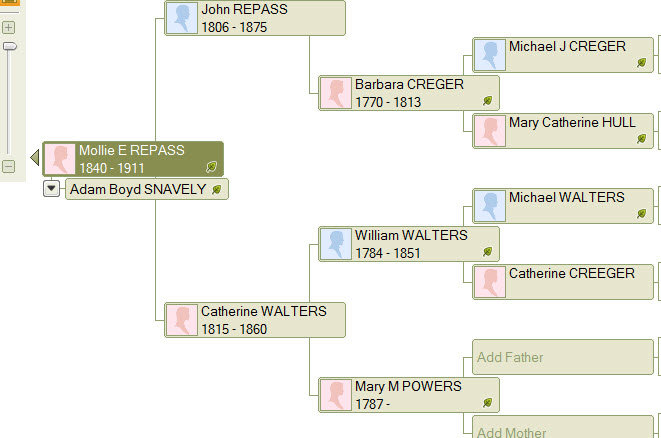
More clicking and I find William Walters and Mary M Powers, my 5th great grand parents; they are also the grandparents of Adam Boyd Snavely’s second wife and my 3rd great grandmother, Mollie E Repass.

more on family graphs03

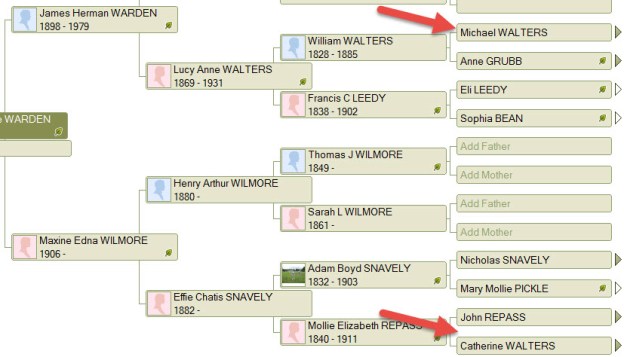
So what does this mean?  James Warden and his wife Maxine Edna Wilmore are both great great great grand children of William Walters and Mary M Powers.  (Below, Catherine and Michael Walters are the children of William and Mary M.)

more on family graphs04

Now there were no amazing ah ha moments.  No brick walls came tumbling down.  And I still don’t know when Effie Snavely Wilmore died.  But southern research is not about researching lines.  It’s about researching communities and how they connect.  It is part of our ancestors’ stories.

I think this has to change how I look at researching people.  I’m just not sure what methods I need to change or add to my process.  But I’m pretty sure I need to adjust my thought process.  I’m not looking for people.  I’m looking for people AND where they fit into their communities.  I suspect that this will break brick walls and add more to their stories.

Stay tuned.

Family Tree or Family Graph

Two weeks ago I presented 5 classes in the Swing through the South class of SLIG 2016. And I never attend a year of SLIG without new thoughts to mull and ponder!

Prepping 5 classes was challenging and enlightening.  And I kept noticing things that I either hadn’t noticed before or that I hadn’t actually formed into coherent thoughts.  Take the concept of family trees.  We all build them.  They show generation after generation of our ancestors and the parents of each ancestor.

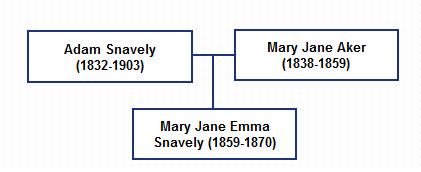
And that is one of the primary goals of genealogy.  Kinship.  But kinship is not just parents.  Especially in southern families.  Here is the most basic family tree for Mary Jane Emma Snavely who lived a very short 11 years on this earth:
family graph01

And we can take both of her parents back a few generations:
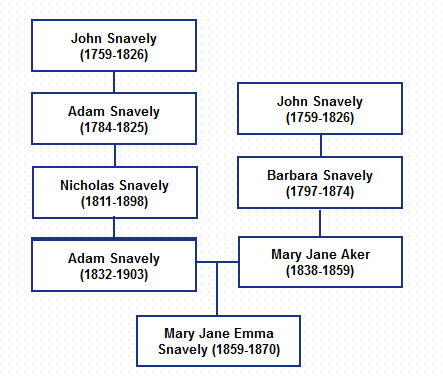
family graph02

And because I suspect you are fairly observant, you noticed that Mary Jane Aker’s grandfather is her husband’s great grandfather.  Ah, those family ties. The tree actually can be better represented as:
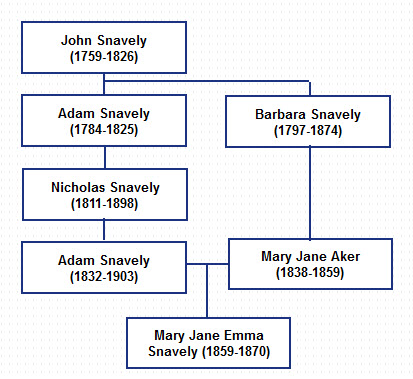
family graph03


But the connectivity doesn’t end there.  Mary Jane’s father was Philip Aker, and Barbara was his second wife.  Guess who his first wife was?
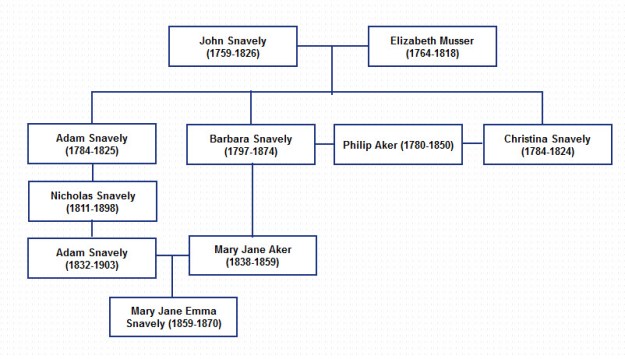
family graph04


Philip Aker first married Christina Snavely and when died he married her sister Barbara.  And I’m leaving out all the other Aker children.  And more than a few of the Snavely family.  But another of John and Elizabeth Musser Snavely’s children was George Snavely.  And he and his brother Adam shared another connection.
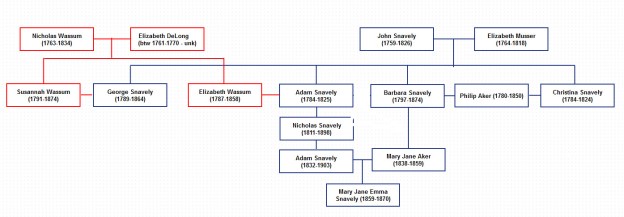
family graph05

Adam and George who were the only two sons of John and Elizabeth Snavely, married sisters, daughters of Nicholas Wassum and Elizabeth DeLong.

To understand the short eleven year life of Mary Jane Emma Snavely don’t we need to examine all these people?  They  appear to be pretty interconnected when  we “graph” them out.  And no doubt the graph gets bigger and more complicated with everyone we continue to add.

Go search your trees.  See if you can find the interconnected families.  How do we represent these graphs that show these relationships in a way that will give us better understanding of who our ancestors were?

Starting with the classic family tree is a must.  You can’t understand the generations if you don’t have it.  But there are a lot of connections we don’t represent, or at least we don’t represent well.  How do we visually  do this so it adds to our understanding and help drive us to those delightful “ah-ha” moments?
 

Did You Know? Where to Find Basic County Information

Many documents our ancestors left behind were in the counties they lived in.  Birth, Marriage and Death records.  Deeds, Wills and other Probate records.

But when were they first recorded? When was the county created?  What were the parent counties?

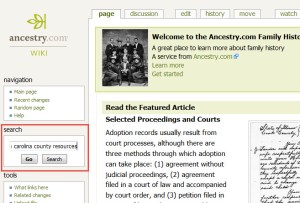
The Ancestry Wiki has the answer for all U.S. counties. In the Wiki search box type state name County Resources :

search box

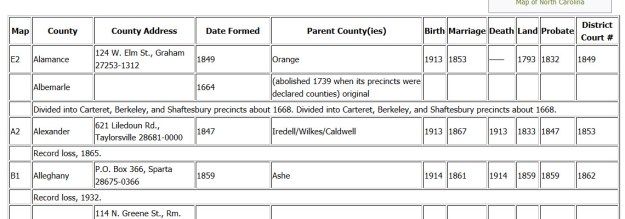
Once you get to the page, scroll down the page and you’ll find a table on the County Resources page that summarizes basic information that will help guide your research in that county.

county table


Great information so you don’t waste time looking for documents that don’t exist.

Where You Can Find Me Speaking This Year

bE2_W402_400x400I didn’t get to travel and speak much last year but this year is picking up!   I’m really glad my schedule is allowing it this year. 🙂

Here is what I know for sure:

There are also a couple of more that need to be confirmed.

And I have 8 Ancestry Academy classes that are live:


Ancestry Academy Launches!

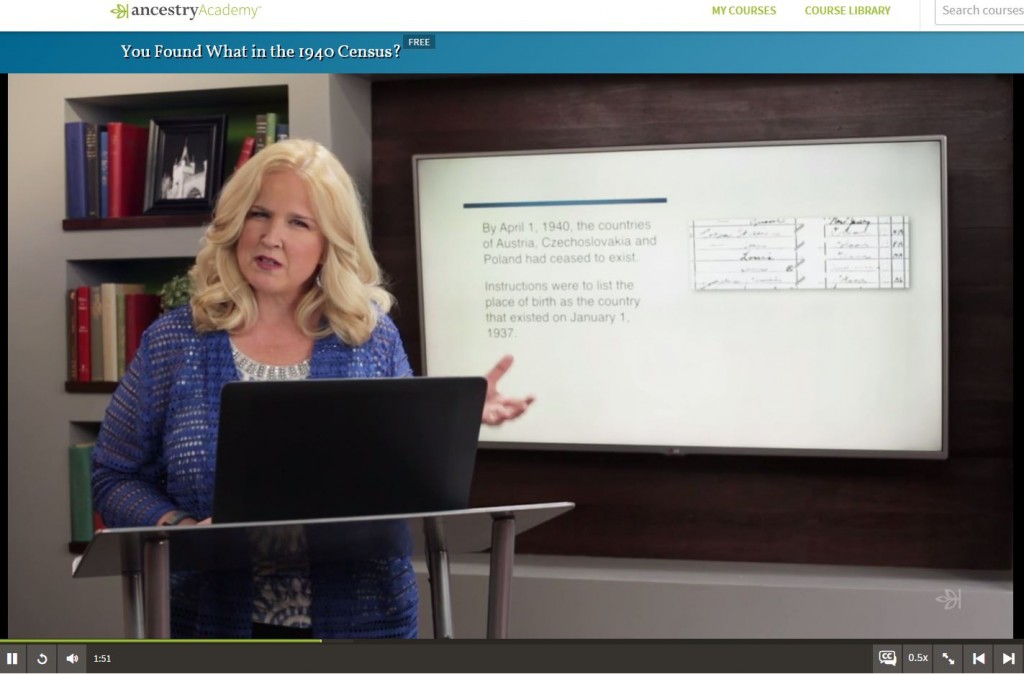
aaOne of my passions is education and another is genealogy.  So you can imagine that being a participant in Ancestry Academy is just all sorts of fun for me!

I currently have 3 classes live:

and two more coming soon:

You will also find a great selection of other course at Ancestry Academy including Paula Stuart Warren discussing Native American Research, J Mark Lowe giving you a new set of tools to analyze the 1790-1840 census records and Juliana Szucs discussing Immigration and Passenger ListsCheck out all 15 and be sure to keep coming back.

I’d love to hear your feedback!

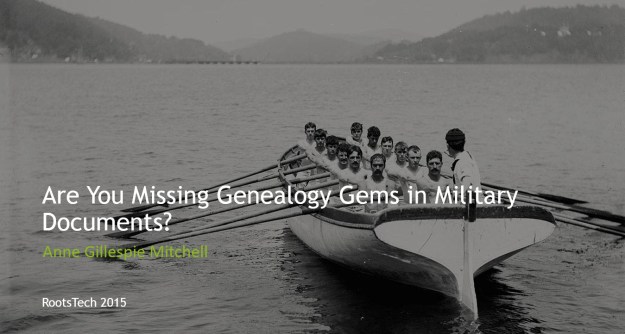
Are You Missing Genealogy Gems in Military Records?

I presented Are You Missing Genealogy Gems in Military Records? at RootsTech 2015 on Saturday.

If you are interested, feel free to check out my slides.

Cover Slides

A look back at 2014: Top Ten Blog Posts

I wasn’t a frequent blogger in 2014, but I did enjoy writing these.  Here are my Top Ten blog posts from 2014 by views.IMG_0563

  1. 52 Ancestors in 52 Weeks! My summary of my 52 Ancestors in 52 Weeks and related articles. Sure I haven’t made much progress but I have organized it!
  2. Come out, come out wherever you are! The hunt for Ancestor #4: Georgia Eva Baxter’s parents. 52 Ancestors. Using the FAN approach to help figure out a mystery.
  3. 52 Ancestors: #1 Laura Cecile Donald All about great granny Laura.
  4. A Few Steps Closer to a Death Date and a Burial Place — 52 Ancestors: #6 Elizabeth Jane Wallace A little guessing and a little detective work gets me closer to my great great grandmother’s resting place.
  5. Returned not used: How I Almost Wasn’t If you assume your ancestor only shows up once in any given data collection you are probably missing something good.
  6. How Eight Children Ended Up Living Alone in 1930 They aren’t just records – they are stories.
  7. I think my great grandmother was a muse. 52 Ancestors: #3 Sarah Sudie Hamrick To understand someone’s life, you need to understand the life of the people around them.
  8. Tuesday’s Tip — Ask Ancestry Anne’s Top 20 Search Tips Need some help with Ancestry search? Here you go.
  9. How an Ancestry Shaky Leaf Solved My Marriage Problem: 52 Ancestors #2: Clara Ellen Hash Because why wouldn’t you go hundreds of miles over a mountain range to get married?
  10. Early Research. Sloppy Research. Lots of Questions. 52 Ancestors #5: Mary Elizabeth Gillespie Oh that nasty sloppy early research.

2014 in review

The WordPress.com stats helper monkeys prepared a 2014 annual report for this blog.

Here’s an excerpt:

The concert hall at the Sydney Opera House holds 2,700 people. This blog was viewed about 16,000 times in 2014. If it were a concert at Sydney Opera House, it would take about 6 sold-out performances for that many people to see it.

Click here to see the complete report.