Category Archives: Genealogy

Ancestors from Outer Space and Constructive Criticism. It’s Follow Friday!

Here’s what I’ve been reading this week:

Two on Archives.com

Slavery-Related Court Petitions Online Database from Genealogy Decoded

Two from The Legal Genealogist

That Was Constructive Criticism, You Fool! from Midwestern Microhistory: A Genealogy Blog

Two stories continued:

And a couple of my posts on Ancestry.com Sticky Notes

Moonshine, Civil War, Newspapers and an Assassin. It’s Follow Friday!

What I’ve been reading and writing this week.  Enjoy!

A couple of To Be Continued posts that you should start reading:

And a little shameless self promotion, my 3 posts in Ancestry.com’s Sticky Notes this week:

Would We All Be Better Genealogists if We Just Got Rid of Trees? Wisdom Wednesday

Oh, I’m serious.  Think of a world where you do genealogy without every creating a family tree.

No tree on Ancestry.com or in Family Tree Maker or whatever your most beloved software or online source is.  Nope.  Never.

Trees are Boring.

Have you ever tried showing a family tree to someone in your family?  What was the reaction?  Was it “this is awesome” or was it “uh, huh.”    The names are meaningless unless you know them.  People like pictures.  People like stories.  There are no visible stories in a family tree.  And the pictures are usually teeny tiny.

Trees are boring

Trees are boring

Everybody else’s trees are full of nonsense/garbage/errors

“If only everyone kept a tree like mine!”  HA! (Not mine personally.  I have tons of stuff to clean up. 🙂 ) The amount of time that gets wasted by those of us in the genealogy community worrying about everybody else’s trees and how many errors and what not are in them, well, we’d get a lot more genealogy done if we weren’t doing that.  And seriously, why do we care?  Just because someone puts a mistake in a tree doesn’t mean you have to believe it.  Or put it in your own tree.  And your ancestor’s are still your ancestors.  And the facts of their lives are still the facts of their lives.  Bad trees don’t change that.

Trees are really just a handy place to hang a record or image

We have no idea why anyone puts any given fact in a tree.  They might attach a record.  But you still have to go look at it and guess that person’s thoughts.  I’d rather not. I’m guessing 99.9999% of all trees do not have attached proof summaries and discussions of why they are entering the data they are entering.  Attached sources are just documents.  They may or may not be evidence of some question that we don’t know.

It’s all about the story.  The emotion.  The picture.

Have you every picked up an interesting lineage? Or some summary of a person or families life and been totally caught up in it?  Made that emotional connection?  Got the chills from a picture?  Because that is what we are after.  Right?  Telling the story.  Making people come back to life.  Honoring those that came before us.  Boxes with lines and a name and a birth date don’t do that.

What if, instead of building trees, we wrote lineages or stories? 

Back away from the tree.  Pick your favorite ancestral couple, and document their life and family.  Include sources and narratives.  And then start working back.  I bet you think it through a whole lot more.   I bet you avoid silly errors and have a better understanding of the people.

Then go show that to someone.  Will you get a “this is awesome” or an “uh, huh” ?

I have come to the point where I truly believe that a tree is not the end goal.  It’s  a  “paint by numbers” genealogy tool if you will.  I want something more than that for my ancestors.

Men in High Heels! Covert Burials! It’s Follow Friday

Here’s some goodies from this past week.

And this series:

Genealogical Proof Standard for Ancestoring’s Ask A Genealogist

Murder! Name Dropping! Reinventing Genealogy? It’s Follow Friday

It’s time for Follow Friday! I missed last week, so this is two weeks worth  of  links.  Happy Reading!

Inauguration Day Dawns Over Washington DC, January 21st, 2013. Motivation Monday.

This morning when I checked my facebook page, I found this, taken by my very talented cousin-in-law, Harrison Moore.

Harrison Moore's photo taken the morning of January 21, 2013

Harrison Moore’s photo taken the morning of January 21, 2013

This was his view of the Washington DC as inauguration day dawned January 21, 2013.

Regardless of how you feel about this particular election or any other, there is something uniquely American in the way our democracy works and how power is transferred or continued.

I wonder how our ancestors felt on various election days and inauguration days.

But mostly I just wanted a chance to share this awesome picture from one of my relatives. 🙂  Thanks Harrison!

What I learned at SLIG 2013: Ponder and Mull. Sorting Saturday.

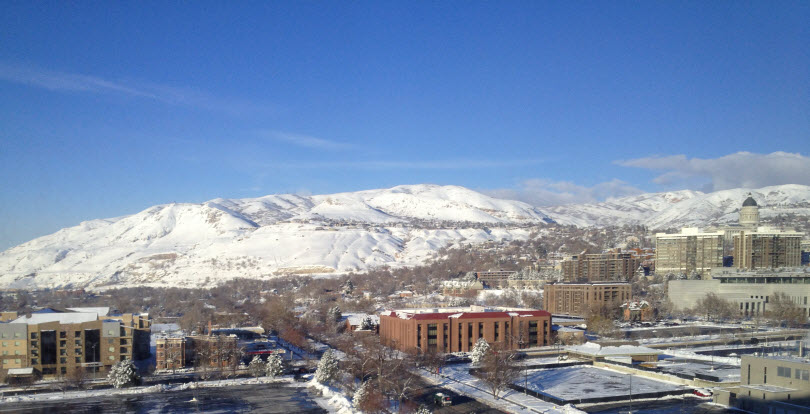
Salt Lake City January 2013

Salt Lake City January 2013

So this past week I have been at SLIG 2013 taking the Advanced Practicum class.  What a great experience it was!

The Advanced Practicum is not your usual week long course where you sit in class.  Every afternoon, we were given a genealogy problem that our instructor had already solved and we then tried our hand at it.  My instructors were Tom Jones, Stefani Evans, William Litchman, Mark Lowe and Jay Fonkert and the coordinators were Angela McGhie and Kimberly Powell

I’m not allowed to discuss the individual cases as they may publish their research or use the cases again.  Fair enough, but I did learn some stuff that is worth remembering:

  1. Start with a written question. What problem are you trying to solve.  Don’t randomly collect records.  Think about what are you trying to do?
  2. Plan!  What do you need to look at to answer the question?  What are the resources that you need; what is available?
  3. Analyze, think, write and repeat as necessary.

You here this all the time, I know.  You read it in blogs.  In classes and conferences.  But boy, when you work through some challenging projects in 24 hours it really makes a difference.

Also:

  1. People must be studied in context.  Don’t just search for names, search in context based on who they are and where they are.  If you don’t understand what they did, where and when they lived it is way to easy to pick  the wrong person or miss something.
  2. Location, location, location.  When you find a person in a location, you must explore that location for records and other people.
  3. Examine all resources.  Sure Ancestry Member Trees and Find A Grave have errors.  But you never know where the next clue will be found.  Make a list of sources.
  4. Keep a research log.  It doesn’t have to be brilliant or well written, but leave notes to yourself so you can pick up where you left off.

And finally, to paraphrase the ever wonderful Mark Lowe, genealogy is all about pondering and mulling.  Back away and think.  🙂

Never Assume Anything. Sixty and Serving. Sorting Saturday.

A couple of days ago I wrote a post The Legal Genealogist Inspires Me to Take Another Look at the Puzzle of Jeremiah which discusses why can I find no record of my 2nd great grandfather Jeremiah Gillespie fighting for the Confederacy?  Or the Union for that matter.

Marian Regan mentioned in a comment that maybe she should go back and look for her ancestor who seemed to old being born in 1817, but who knew?  Maybe he did fight.  It is not out of the realm of possibility.

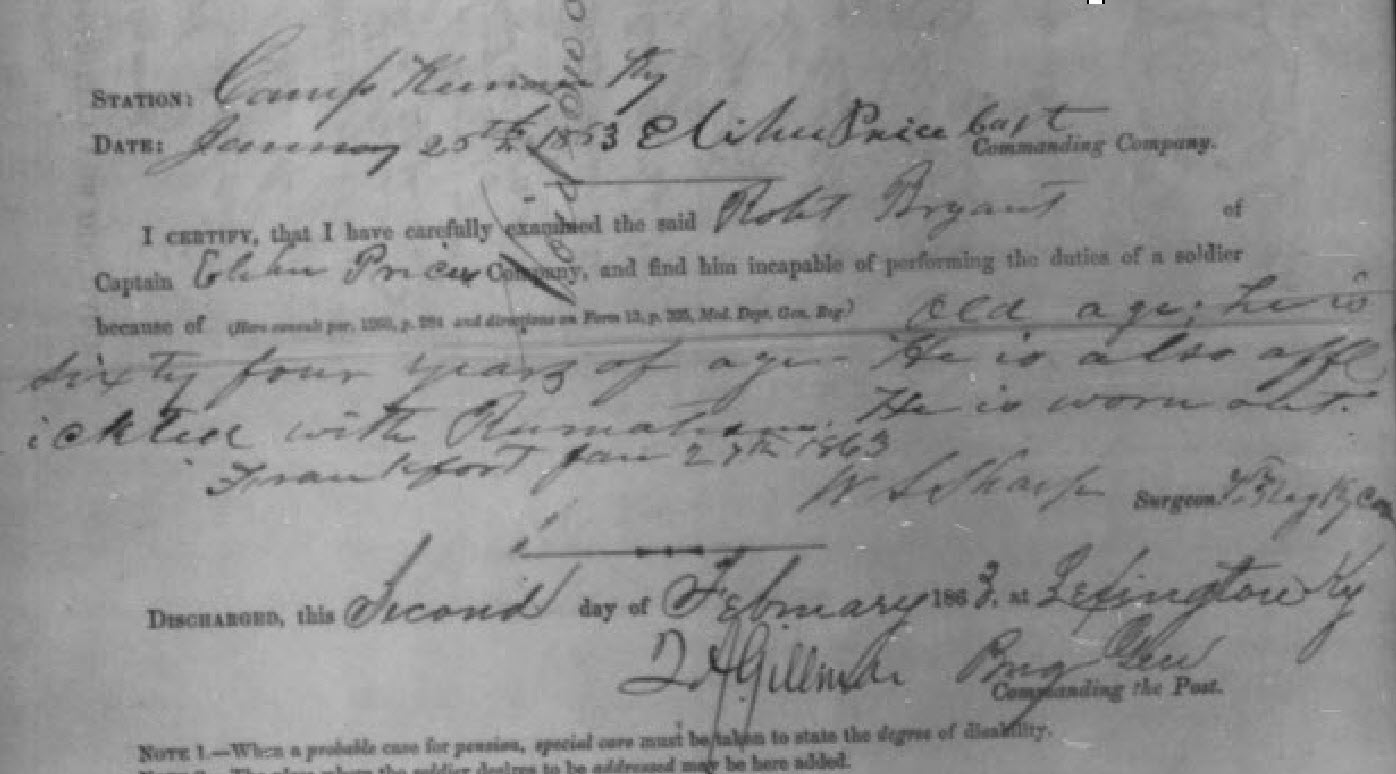
Robert Bryant discharge

Robert Bryant discharge. Reasons include “old age” and “he is just worn out.

In 2011 I wrote a series of 6 posts for Ancestry.com on the Civil War.  The last 4 were about Robert Bryant, who was born about 1802.  Yep, 1802.  He fought for the 7th Kentucky Calvary (Union) and died from complications from a skin infection in a military hospital.  Don’t assume anything! 🙂

My two introductory posts:

Four posts about Robert Bryant:

I sometimes regret publishing these — they would have been an awesome case study for conflicting evidence for my CG.  It is what it is.

Pig Farmers, Copywrongs and other Genealogical Musings. Follow Friday.

Here are blog posts from this week you might have missed.  Lots of good reading in here!

The Legal Genealogist Inspires Me to Take Another Look at the Puzzle of Jeremiah. Treasure Chest Thursday

I just read Judy Russell’s blog post The drafty Ohioan in her blog The Legal Genealogist where she discusses why Ignatius or Ignatz Fleitz didn’t fight for the Union during the Civil War.  Her discussion focuses  on laws at that time and what the possibilities were for not fighting.

And of course my 2nd great grandfather, Jeremiah Gillespie, pops into my head.  His older brother Everett Milton enlisted.  His younger brothers Varlan, William and John all have enlistment paper trails.  But I have never found any record of Jeremiah fighting.  Why not?  He lived in Amherst County, Virginia in 1860 and in 1870.  The Confederacy by the end of the war had almost every male between the ages of 17 and 50 fighting.1

So how old was Jeremiah during the Civil War?  His birth year has always been a bit fuzzy, but here is what we know.  I have a record of a bible page, that lists his birth date as March 4, 1826.2
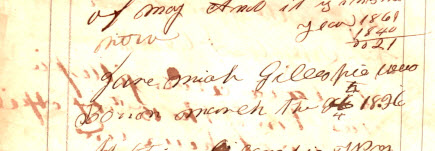
Jeremiah Gillespie's birth date in the Gillespie Family Bible

Jeremiah Gillespie’s birth in the Gillespie Family Bible: March 4th 1826

His marriage as it is recorded in the Amherst marriage register suggests that he is was born in 1828 or later.  He is married November 21, 1848 and as listed as underage (under 21).  If he were born March 4th, 1828, he would have been twenty.  For the sake of argument, let’s assume he was born either March 4, 1826 or 1828.

Register entry for Jeremiah and Mary Gillespie

Register entry for Jeremiah and Mary Gillespie

I build a table to see how old Jeremiah was on the dates of various Conscription Acts:3

Dates and Age of Jeremiah for 3 Confederate Conscription Acts

Dates and Age of Jeremiah for 3 Confederate Conscription Acts

From this table, we see that at least by July 15, 1863 he should have enlisted in the war.  Why didn’t he?  What exemptions were there?

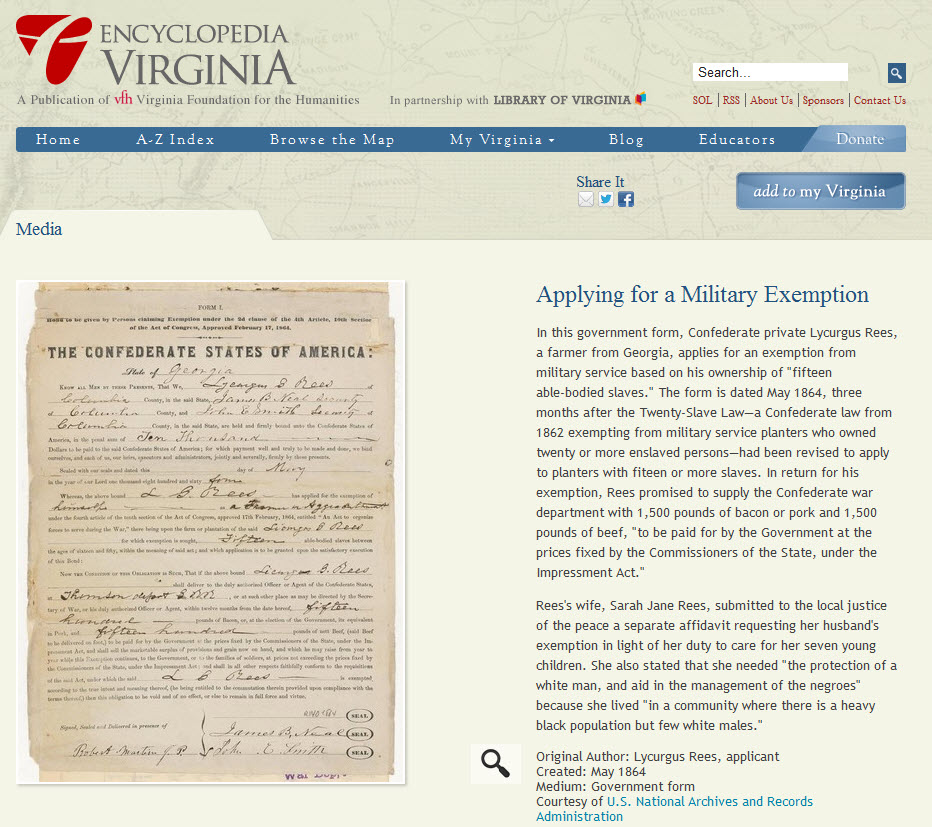
On October 11, 1862, the Confederate Congress passed what was known as the Twenty Slave Law allowing men who owned over 20 slaves exemption from service.4 But the 1860 slave schedule shows us that Jeremiah owned no slaves. The only Gillespie in Amherst County who is listed as owning slaves in 1860 is Wyatt Gillespie, whom I believe to be Jeremiah’s brother-in-law.5 I don’t think it was the Twenty Slave exemption.

I do notice something interesting on the Encyclopedia page. It’s a picture of document used for Applying for a Military Exemption. Can anyone say “To Do List!”

It was possible for a man to purchase a substitute for $300.  But I don’t believe that Jeremiah was a man of much means. In 1860, he declares he has real estate worth $300 and a personal estate of $50; his occupation as a farmer.6  Sure, anything is possible, but I don’t think this is it.

The Confederacy did exempt men who worked in occupations “such as railroad and river workers, civil officials, telegraph operators, miners, druggists and teachers.”7

So I have two possibilities:

  1. He enlisted and I just haven’t found the right record yet or
  2. He has an exemption, and I should try searching for that paper work.

And I always wanted to believe he was a spy! But for now, I’m going to try and track down exemption records.  The answers are out there.

Footnotes

1. Wikipedia (http://www.wikipedia.org), “Confederate States Army,” rev 4:16, 31 Dec 2012.
2. The Holy Bible, (New York, American Bible Society, 1857), “Family Records, Births”, p840; privately held by Anne Gillespie Mitchell, [ADDRESS FOR PRIVATE USE,] California, 2012. The sons of Tarlton and Mahala Gillespie are listed with their birth dates; it appears that they were all written at one time and are dated April 20 1860.
3. Wikipedia, “Confederate States Army,” rev 4:16, 31 Dec 2012.
4. Lee, Susanna Michele, “Twenty-Slave Law,” Encyclopedia Virginia (http://http://encyclopediavirginia.org/ accessed : 10 Jan 2013); Foundation for the Humanities, 31 May 2012
5. 1860 U.S. census, Amherst County, Virginia, slave schedule, Gill?spie; NARA microfilm publication M653.
6. 1860 U.S. Federal Census, Amherst County, Virginia, population schedule,, p. 132 (penned), dwelling 979, family 977, Jaremiah Gillispie; digital images, Ancestry.com (http://www.ancestry.com accessed : 18 Jul 2012); citing NARA microfilm publication, M653, roll 1332.


7. CJ’s Civil War Home Page (http://www.wtv-zone.com accessed : Jan 10 2013 ), “Confederate Draft.”